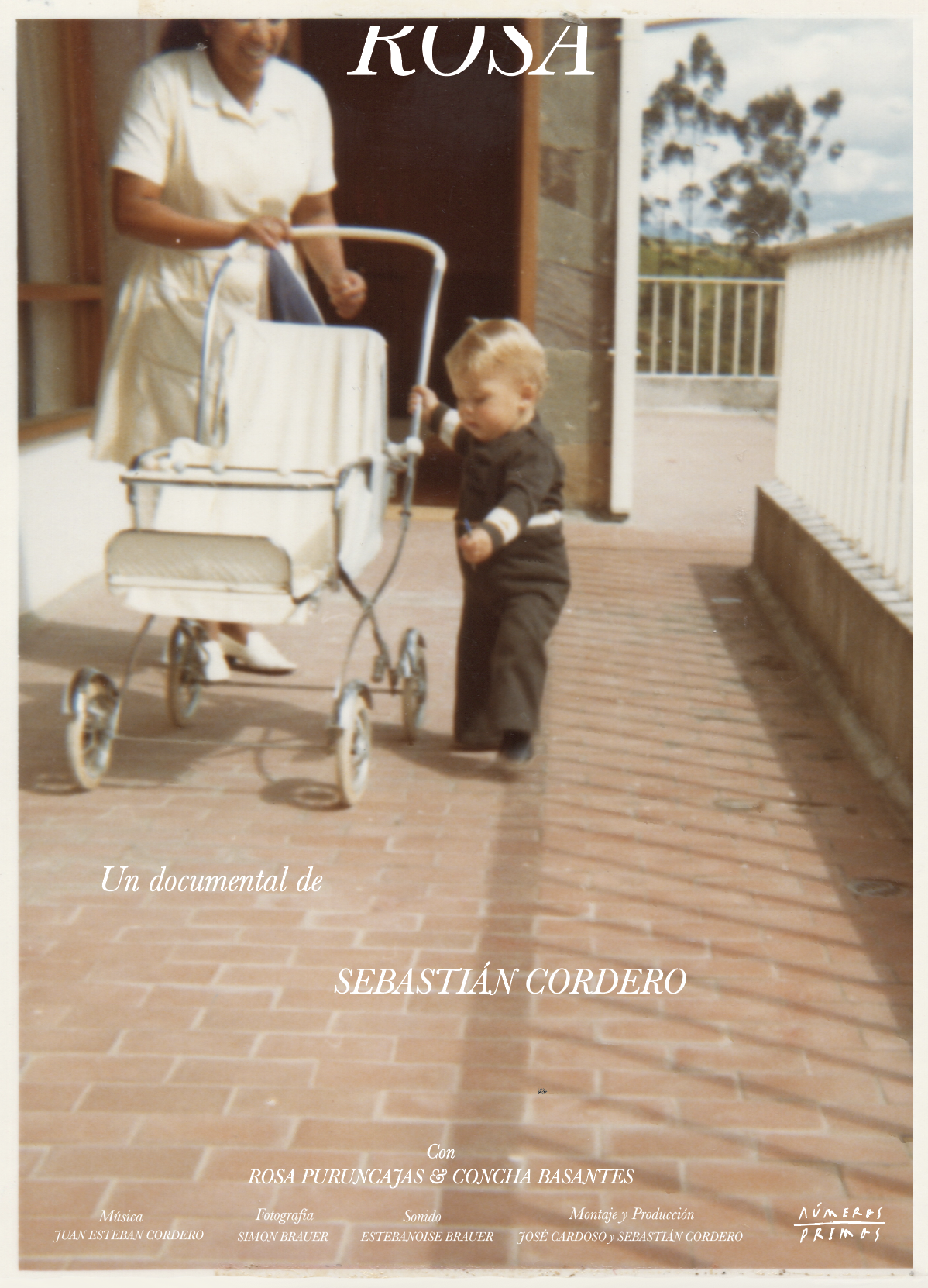
A documentary film by Sebastian Cordero.
Length: 114 minutes.
Lenguage: Spanish
Format: DCP
Subtitles: English
Sound: Stereo/Dolby 5.1
SYNOPSIS
The lifelong relationship between Sebastián Cordero, a Latin American filmmaker, and his nanny Rosa Puruncajas, who is like a second mother to him.
Rosa is a woman who dedicated her entire life to someone else’s family, which is the reality of many “live-in” maids in Latin America, working with the director’s family for over fifty years, before he was even born.
As Sebastián delves into Rosa’s past looking to portray her life, he encounters isolated anecdotes, some of them lacking context, with a hazy timeline.
Rosa seems more comfortable telling the story of the director’s family, which is not her story, while at the same time it is.
The collision between his and her memories leads the director to reflect upon his own personal story and to question himself about a life of privilege.
In a family where archival material is abundant, it becomes ironic that Rosa, who has very little archive of her own life, becomes the narrator of the director’s family history and its unexpected twists.
DIRECTOR STATEMENT
“I’ve been always fascinated by the way Rosa tells stories. Whether it’s an anecdote or a recollection from the past, she always uses circular narration, going back to the same ideas, repeating herself over and over, while sometimes changing the story she’s telling. As a writer who prides himself in avoiding redundancies and trying to get to the point as efficiently as possible, it’s always a surprise to realize how much I find Rosa’s storytelling gripping.
When Rosa was my nanny, she was the first “narrator” I was exposed to, and she gave me the best gift a child could hope for (besides nurturing, caring and being a second mother!), which is the wonder and awe of storytelling.
When Rosa was about to celebrate her 80th birthday, I realized I had never filmed her, and I needed to do so with urgency: I wanted to capture her way of talking to me, and the pretext was to record this momentous moment in her life. I went to her home with a small crew, and we started talking about life (hers as well as mine).
Having lunch at Rosa’s is like going back in time: not only do I eat the same food I ate as a kid, but she keeps and uses the same dishes and silverware which we used at home. Her bedroom is filled with paintings and religious figures that were in my mother’s bedroom, and a poster with a marijuana leaf loses its external meaning and becomes an altar to remember my dead brother. Objects become a way of clinging to the past, for her and for me, and they become sacred keepers of memory, even though many of these objects were “leftovers” from my family house, which were going to be disposed of. And which Rosa saved. Through these objects and her stories, Rosa becomes a narrator of my family’s life.
But when I try to illustrate her tales with archive from my family’s photo albums and my father’s super 8 family films, we both notice that Rosa is seldom portrayed there, even though she was very often present off camera. And so, I feel an obligation to tell her story too, but in the process, I realize there will be some uncomfortable moments, and that Rosa often prefers to tell my family’s idealized life rather than to expose the “leftovers” she inherited from us.
And as I continue, I keep exposing what I’ve always known and rarely talk about: my reality with Rosa is common in many Latin-American households, and I’m lucky that in my case, we hold no resentment towards one another. But of course, from my perspective, how could I feel resentment, given that she could never discipline me? Is this then a one-sided relationship? It would be hypocritical not to analyze this story without considering that, but it’s clear to me that the love is not, and never was, one-sided. Even though Rosa is not my mother, she certainly feels like one.”
Sebastián Cordero
LOGLINE
The lifelong relationship between Sebastián Cordero, a Latin American filmmaker, and his nanny Rosa, a woman who dedicated her entire life to someone else’s family. While Rosa has very little archive of her own life, she becomes the narrator of the director’s family history and its unexpected twists. This is, and isn’t, her story.
DIRECTOR BIOGRAPHY
SEBASTIÁN CORDERO (Ecuador, 1972).
Ecuadorian filmmaker, born in Quito. He spent his teenage years in Paris and studied filmic writing at USC in Los Angeles.
Writer, director, and editor of RATAS, RATONES, RATEROS (Ecuador, 1999), his first film, which premiered in Venice and became a social and cultural phenomenon in Ecuador.
His next film CRONICAS (Mexico-Ecuador, 2004) premiered at Cannes and received several international awards. RABIA (Spain-Colombia, 2011) won the Special Jury Prize in Tokyo and four awards in Málaga, including Best Picture. PESCADOR (Ecuador-Colombia, 2011) marked a sharp turn towards a freer improvisational process, which contrasted starkly with the scientific rigor of the sci-fi thriller EUROPA REPORT (US, 2013), his US/English-language debut. In 2016 he premiered SIN MUERTOS NO HAY CARNAVAL / SUCH IS LIFE IN THE TROPICS (Ecuador-Germany-Mexico, 2016), a portrait of the city of Guayaquil, which was Ecuador’s Official Selection for the 2017 Oscars.
Sebastián has been an advisor at the Sundance Writing Labs in the US and the Bertha Navarro labs in Mexico. In 2013 he founded the Screenwriting Lab for Andean countries in Cuenca, Ecuador, which he co-directs with Bertha Navarro. He is a member of the Academy of Motion Picture Arts and Sciences (AMPAS).
He ventured into immersive theater with great success with RABIA (performances in Guayaquil and Quito, 2019-2020), and continues with classical theater by staging adaptations of Sartre’s SIN SALIDA (2023) and LA MISMA SANGRE (2024, 2025).
He recently explored auteur documentary with AL OTRO LADO DE LA NIEBLA (Ecuador, 2023) and ROSA (Ecuador, 2025), while preparing his first feature film for Netflix.
 Jiráfica